
What Is Googlebot and Why It Matters for Your Business Website
By Daclaud Lee – SEO Consultant at Archmore Business Web
Most business and website owners assume that when Google scans the internet, there is just one robot doing the work. For years people in marketing simply called it “Googlebot” and left it at that. But the reality today is much more complicated, and understanding it can help you see why your business website ranks the way it does.
Take a moment to watch this video about Google crawlers behind the scenes. Or you can just skip it if you want.
I am basically going to summarize the takeaway from the video below.
Googlebot Explained in Simple Terms
In the early days of Google, there really was just one crawler called Googlebot. It visited websites, read the pages, and stored that information so it could appear in search results. That simple model worked when Google was just a search engine.
Fast forward to today and Google is running search, maps, ads, shopping, AI systems, image recognition, and more. Each of those systems may have its own crawler pulling information from the web.
So when people say “Googlebot,” they are really talking about an entire ecosystem of bots pulling data from the internet. But it was usually known as “the thing that crawled your website” or a web crawler.
What is a Web Crawler and what Does it Do?
A web crawler is basically a robot that visits websites automatically.
It reads the pages on your site and sends that information back to Google. That is how Google knows what your website is about and when to show it in search results.
Think of it like a librarian cataloging books. The crawler scans the page and helps Google understand the content.
How Many Web Crawlers Are There?
Google is no longer just a simple search engine.
They have many properties such as:
- Search
- Google Images
- Google News
- Google Ads
- Google Shopping
- AI systems
- Many other products
Each product needs data from the internet. That means more crawlers.
Some crawlers are designed to scan entire websites, while others pull specific types of data such as images, product information, or structured content.
Not All Crawlers Are Publicly Listed
Google documents some of its major crawlers so website owners know what they are. But there are many smaller crawlers that are not publicly documented.
Why? Because Google is a massive company with many teams building different products. If they documented every crawler, the list would be enormous.
So the reality is that your website may be visited by multiple Google systems you have never heard of. Some crawl data and some fetch data.
Crawlers vs Fetchers
Google also explained something interesting. There are two different tools working behind the scenes.
Crawlers constantly scan the internet looking for new pages and updates.
Fetchers retrieve individual pages when something specifically asks for them.
Both systems collect information that eventually feeds into Google’s search results and other products.
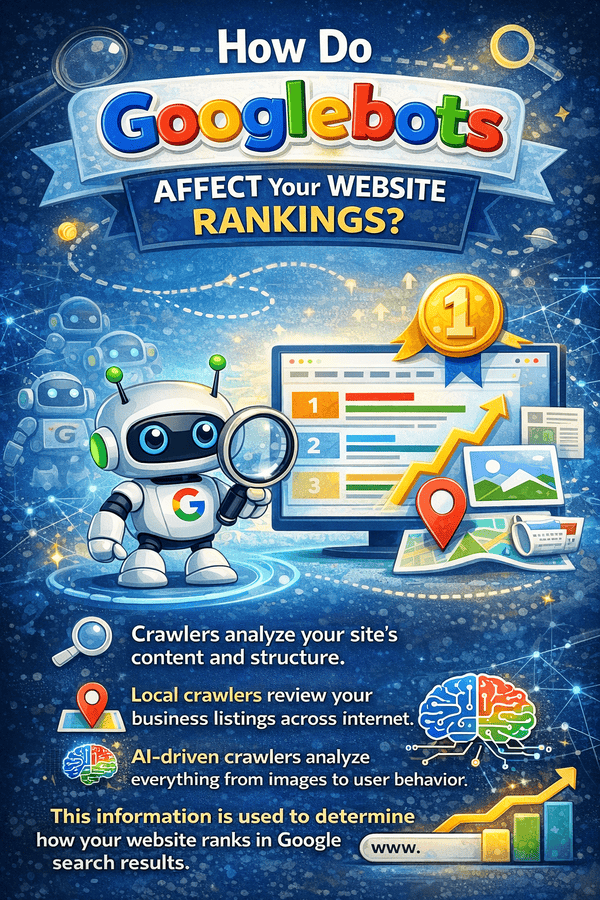
How Do Googlebots Affect Your Website Rankings?
This is where things get interesting for business owners.
Your website is no longer just being evaluated by one search crawler. Multiple Google systems may be collecting information about your business.
Some systems analyze content. Others analyze images. Others evaluate reviews, business listings, or structured data.
This means ranking in search is no longer just about what is on your website.
Your digital footprint across the entire internet now matters.
There Are Many Things You Need to Do to Optimize Your Website.
- Build Strong Website Content
- Have a Good Website Structure
- Get More Reviews
- Build More Social Signals
- Get NAP Citations
I will explain all of this in detail below. You can either do it yourself or hire Archmore Business Web as your AI and SEO partner.
Build Strong Website Content
Content is still important. There is the old saying that “content is king”, and it’s debatable whether or not this holds true, but it in a way it does. Your website needs clear pages that explain your services, location, and expertise. If you don’t have this, then Google won’t know where to put you in their eco-system.
Good content (more than 500 words of sales copy) helps Google understand what your business actually does.
But content alone is not enough anymore.
Structure Your Website Properly
Search engines rely heavily on structure.
Using proper headings, organized pages, and clear navigation helps crawlers scan your website efficiently.
Think of it as making your website easier for robots to read and understand.
Keep Your Business Information Consistent
Your business name, address, and phone number (NAP information) should be the same everywhere online. This is called Off Page SEO, because it’s done off your website.
If your information is inconsistent across different websites and social media platforms, it can confuse search engines and hurt your credibility.
Encourage Real Customer Reviews
Reviews are becoming one of the strongest ranking signals for local businesses (at least in 2026, but this could change)
When customers leave detailed reviews mentioning your services, it reinforces what your business is known for.
Search engines use those signals to understand your reputation.
Build Mentions Across the Internet
Your business should appear in more places than just your website.
Your mention across the internet should include:
- Business directories
- News articles
- Social media
- Industry websites
- Online listings
The more your business appears across the internet, the easier it is for search engines and AI systems to recognize your authority.
What Does This All Mean?
Googlebot is not just one crawler anymore. It is an entire ecosystem of bots collecting information from the internet for different Google products.
For business owners, the takeaway is simple.
Your website is still important, but your overall digital footprint matters even more.
The businesses that rank well today are the ones that show up consistently across the internet, not just on their own website.
Author Bio
Daclaud Lee is an SEO and AEO consultant with over a decade of experience helping businesses improve their online visibility through Archmore Business Web. He specializes in on page SEO, content strategy, and adapting websites to the evolving world of AI driven search. Daclaud began experimenting with AI tools for marketing years before ChatGPT became mainstream and now focuses on helping businesses build strong digital footprints that perform well in both traditional search and AI answer engines.