


SEO for divorce attorneys

SEO for Divorce Attorneys

By Daclaud Lee – SEO / AEO / AIO Consultant

When someone needs a divorce attorney, one of the first places they often turn is Google. A strong SEO strategy can help your law firm appear when potential clients are actively searching for divorce and family law services in your area. In this guide, we’ll cover practical SEO tips for divorce attorneys and explain how professional SEO can help your firm generate more qualified leads.

How to Get Your Law Firm Found Online

When someone searches for a divorce attorney, you want your law firm to appear before your competitors. SEO for divorce attorneys helps improve your visibility in Google Search, Google Maps, and local search results so potential clients can find your firm when they need legal help.

At Archmore Business Web, we help law firms build stronger search visibility through local SEO, website optimization, content development, keyword targeting, and technical SEO. The goal isn’t simply to generate more website traffic. It’s to help your firm get discovered by people who are actively searching for the divorce and family law services you provide.

Throughout this guide, we’ll show you some of the same strategies we use to help businesses improve their search presence, so you can start applying them to your own law firm’s website.

The Basics of SEO for Divorce Attorneys

SEO for divorce attorneys does not need to start with complicated strategies. The foundation is making sure Google can clearly understand what legal services you provide, where you provide them, and why your law firm is a credible and trustworthy choice. Here are ten areas we recommend focusing on.

1. Define Your Service Areas

Start by identifying the cities, counties, and communities where you actually want to attract divorce and family law clients. Your geographic targeting will influence your website content, local keywords, Google Business Profile strategy, service area pages, and local citations.

Do not simply target every city within 100 miles. Focus on markets where you realistically practice and where attracting new clients makes business sense.

2. Set Up and Optimize Your Google Business Profile

Your Google Business Profile is one of the most important components of local SEO. Make sure your business name, address, phone number, website, hours, categories, services, photos, and other information are accurate and complete.

Your primary and secondary categories should also accurately reflect your practice. The goal is to give Google clear information about your law firm while giving prospective clients enough information to determine whether you can help them.

3. Create Rich Service Content That Demonstrates E-E-A-T

Do not settle for a single page that simply says you handle divorce cases. Build substantial content around the legal services you actually provide, such as divorce, dissolution, child custody, child support, spousal support, property division, and other applicable areas of family law.

Your content should demonstrate Experience, Expertise, Authoritativeness, and Trustworthiness (E-E-A-T). Discuss the questions clients commonly ask, explain relevant legal concepts, introduce your attorneys and their experience, and provide genuinely useful information instead of simply repeating keywords.

4. Connect Your Social Media and Post Regularly

Maintain active, consistent social profiles and connect them to your overall online presence. You can share articles, legal updates, answers to common questions, firm news, videos, and other useful information.

Social activity is not a substitute for traditional SEO, but it can strengthen your broader digital footprint and create additional content and entity signals that may be surfaced or referenced across traditional search, AI Overviews, and other AI-driven discovery experiences.

5. Build Backlinks and Local Citations

A backlink is a link from another website to yours. A local citation is an online reference to your law firm, typically including information such as its name, address, and phone number.

Look for legitimate opportunities through local organizations, professional associations, chambers of commerce, community involvement, legal directories, sponsorships, media coverage, and useful content that other websites may naturally reference. Quality and relevance matter much more than simply accumulating hundreds of links.

6. Create Profiles on Major Attorney Directories

Attorney directories can provide additional places for prospective clients and search engines to find information about your practice. Depending on your jurisdiction and eligibility, directories and professional profiles worth evaluating include Avvo, FindLaw, Justia, Lawyers.com, Martindale-Hubbell, Super Lawyers, Nolo, and HG.org, along with relevant state and local bar association directories.

These profiles can provide citations, referral traffic, reputation signals, and, in some cases, backlinks and reviews. Keep your law firm’s information consistent across these platforms. You do not necessarily need to pay for every premium directory package simply because one is offered.

7. Build Service Area Pages

If you serve multiple communities, create useful service area pages for your most important markets. For example, instead of relying exclusively on one general divorce attorney page, you might have pages targeting specific cities where you genuinely provide services.

Do not simply duplicate the same page and swap the city name. Add information relevant to that location and the clients you serve there. Strong service area pages should be useful enough to stand on their own.

8. Consistently Ask Clients for Reviews

Reviews are particularly important for a business where trust plays such a significant role in the hiring decision. Encourage satisfied clients to leave honest reviews on appropriate platforms, especially Google.

Reviews can strengthen your reputation and local presence while providing prospective clients with independent evidence of other people’s experiences with your firm. They can also contribute to the broader trust and reputation signals surrounding your business online.

9. Post to Your Google Business Profile

You do not need to publish something every day. Instead, periodically use your Google Business Profile to share genuinely useful information.

You could discuss changes to divorce or family law, answer common questions, share new articles from your website, or highlight relevant firm news. The objective is not to post for the sake of posting. Use the profile as another place to demonstrate that your firm is active and knowledgeable about its practice areas.

10. Blog About the Questions Your Clients Are Actually Asking

A good legal blog should answer the questions prospective clients are typing into Google. Topics might include how property is divided during a divorce, how child custody works, what happens to a house during divorce, how long a divorce takes, or what someone should bring to their first consultation.

Provide genuinely helpful information rather than writing articles solely to target keywords. These articles can strengthen your website’s topical depth, demonstrate your attorneys’ expertise, create internal-linking opportunities, and give you useful content to share through your Google Business Profile and social channels.

Case Study: Divorce and International Divorce Attorney

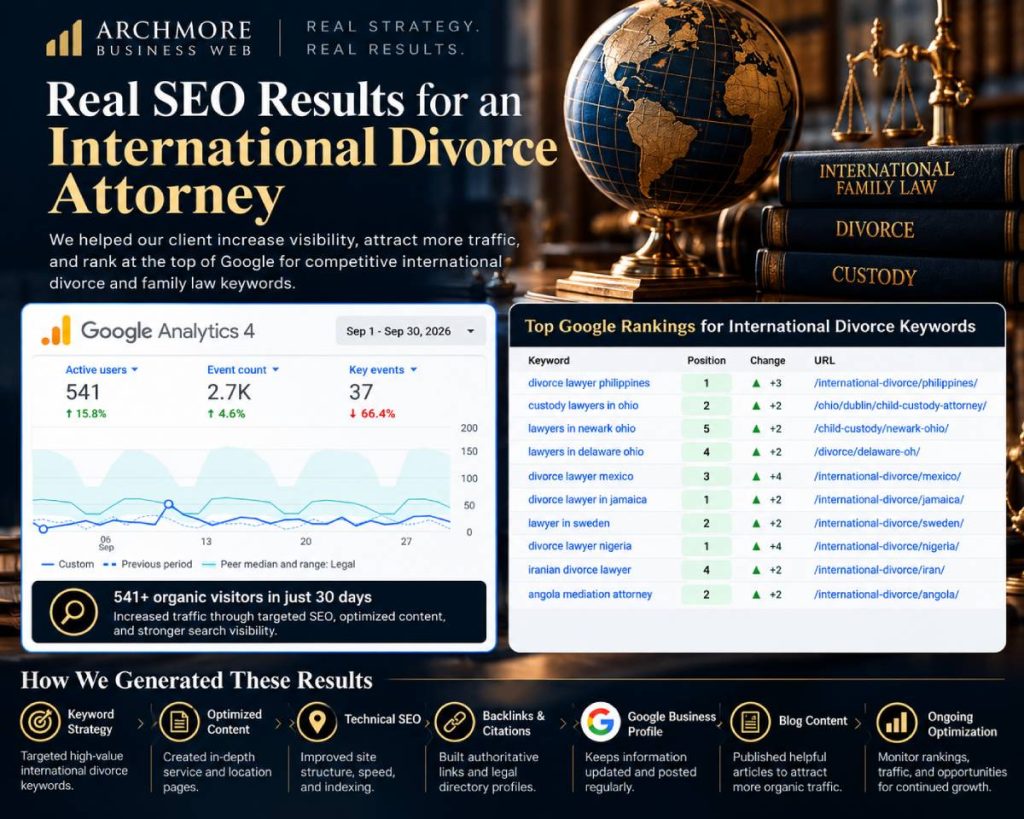
Getting these results did not come from optimizing a handful of keywords. We built out the website around the attorney’s actual practice areas, geographic reach, and international divorce services. This gave search engines a much clearer understanding of what he does, where he practices, and the specific types of clients he can help.

International divorce attorney SEO

1. We Built Pages for Each of His Legal Services

Instead of trying to make one general page rank for everything, we created and optimized dedicated pages around his individual practice areas. This allowed us to target more specific searches while providing potential clients with detailed information about the services they were looking for.

  • Family Law
  • Divorce Law
  • International Divorce Law
  •  Child Custody
  • Dissolution
  • Child Custody Across Multiple States
  • Hague Convention
  • Spousal Support
  • International Child Abduction
  • Domestic Appeals
  • Family Mediation and Arbitration
  • International Family Law

2. We Optimized for the Countries Where He Handles International Divorce

International divorce is one of his specialties, so we expanded the website around the individual countries relevant to his practice. Instead of relying solely on a general International Divorce page, we created country-specific content designed to answer more targeted searches.

This is how the website began ranking for searches such as Divorce Lawyer Philippines, Divorce Lawyer Mexico, Divorce Lawyer Jamaica, Divorce Lawyer Nigeria, Iranian Divorce Lawyer, and other international divorce terms.

3. We Targeted the States Where He Handles Child Custody Matters

We applied a similar strategy to multi-state child custody. We created and optimized content around the states where he is able to handle these matters, giving Google more specific pages to match with people searching for child custody attorneys and information involving those states.

4. We Optimized for Cities and Towns Throughout Franklin County

We also built out the firm’s local SEO presence. This included optimizing the website for the individual cities and communities throughout Franklin County where potential clients may be searching for divorce and family law attorneys.

Rather than simply targeting broad terms like Divorce Attorney Columbus Ohio, this strategy allows the firm to compete for more specific local searches throughout its actual service area.

5. We Expanded the Strategy to Relevant Counties

Our geographic strategy did not stop with individual cities. We also optimized the website around the counties where the attorney is able to practice and wants to attract clients.
This creates multiple layers of geographic relevance, allowing the website to target city, county, state, national, and international searches depending on the particular legal service.

6. We Continue to Strengthen the Website Using E-E-A-T

SEO is not finished once a page starts ranking. We continue reviewing and improving the website based on E-E-A-T: Experience, Expertise, Authoritativeness, and Trustworthiness.

That means strengthening existing content, demonstrating real legal knowledge and experience, improving trust signals, keeping information useful and current, and continuing to build the firm’s authority around the areas of law it actually practices.

The result is a website built around the attorney’s real expertise rather than a collection of generic SEO pages.

Frequently Asked Questions About SEO for Divorce Attorneys

What Is SEO for Divorce Attorneys?

SEO for divorce attorneys is the process of improving a law firm’s visibility in search engines for searches related to divorce, family law, child custody, and other relevant legal services. The goal is to help potential clients find your firm when they are actively searching for the services you provide.

Many potential clients begin their search for an attorney online. Strong SEO can help your firm appear for relevant searches at the moment someone is looking for legal assistance, increasing your visibility and opportunities to generate qualified leads.

SEO is a long-term strategy, and there is no guaranteed timeline. Competition, your existing website authority, location, content, backlinks, and the keywords you are targeting can all affect how quickly rankings improve.

Divorce attorneys should generally target keywords related to their actual services and geographic markets. Examples include Divorce Attorney, Family Law Attorney, Child Custody Lawyer, International Divorce Attorney, and combinations such as Divorce Attorney + City or Divorce Attorney + County.

For firms seeking local clients, a well-optimized Google Business Profile can be an important part of local SEO. Keep your business information accurate, select appropriate categories, add relevant information and photos, and consistently work on earning legitimate client reviews.

Reviews can support local visibility and provide important trust signals for prospective clients. Encourage satisfied clients to leave honest reviews, but never buy reviews or attempt to manipulate ratings.

Yes, when there is enough useful information to justify them. Divorce, child custody, dissolution, spousal support, mediation, international divorce, and other distinct practice areas can benefit from dedicated pages rather than forcing every service onto one general family law page.

City and service area pages can help a firm target relevant geographic searches, but each page should provide genuine value. Avoid creating dozens of nearly identical pages where the only difference is the city name.

Blogging can help attorneys answer questions potential clients are already searching for while demonstrating knowledge and building topical depth around their practice areas. Focus on useful legal information and questions relevant to the firm’s actual clients rather than publishing articles simply to add keywords.

SEO can increase a firm’s visibility among people searching for divorce and family law services, which can create more opportunities for inquiries and consultations. However, rankings and leads are never guaranteed, and results depend on factors such as competition, market demand, website quality, reputation, and the strength of the overall SEO strategy.

Yes. Archmore Business Web can evaluate your current search presence, identify opportunities, and develop an SEO strategy around your practice areas and geographic markets. Start with an SEO Report Card to see what’s working, what needs improvement, and where your law firm has opportunities to grow.

About the Author

Daclaud Lee is a digital marketing professional, author, and business consultant who has worked in SEO since 2010. A graduate of Franklin University’s Digital Marketing program, he has spent more than 15 years helping businesses improve their online visibility through search engine optimization, website development, content strategy, and digital marketing.

Through his work as a SEO consultant, Daclaud combines hands-on SEO experience with a practical understanding of how businesses use their websites to attract customers and generate leads. He also writes on topics related to SEO, digital marketing, business, and technology.

More From the Blog

Want to learn more about SEO, website optimization, and digital marketing? Explore more articles from the Archmore Business Web Blog for practical tips, strategies, and insights you can use to improve your website and online visibility.

Continue exploring the Digital Marketing Journal and discover more ways to grow your online presence with Archmore Business Web.

SEO Report Card

SEO Report Card

How well is your website actually performing in Google Search? An SEO Report Card gives you a straightforward look at your website’s search visibility, keyword rankings, content, technical SEO, and other important performance factors. We can generate an SEO Report Card to identify what your website is doing well, where problems may exist, and where there are opportunities to improve your rankings.
Read More »
Google Search Console in action

How to Use Google Search Console For Technical SEO

Google Search Console gives you a direct look at how Google discovers, crawls, indexes, and understands your website. By using real data from Google rather than relying on guesswork, you can identify indexing problems, crawl issues, Core Web Vitals concerns, and other technical problems that may be limiting your visibility in search results. In this guide, we’ll show you how we use Google Search Console for technical SEO to find problems, verify fixes, and help keep websites healthy and accessible to search engines.
Read More »
What is Position 0 cover showing an example

What is Position 0?

Ranking on the first page of Google is no longer the only goal. Many searches are answered before users even click a website, thanks to Position 0, also known as a Featured Snippet. Earning this coveted placement can dramatically increase your visibility, establish your business as an authority, and drive more qualified traffic, even above the #1 organic search result.

Read More »

How to Track SERP Position

Tracking your SERP (Search Engine Results Page) positions is one of the most important parts of any SEO strategy. By monitoring keyword rankings, businesses can measure the effectiveness of their SEO efforts, identify new opportunities, and spot ranking declines before they impact traffic and leads. Whether you’re managing a local business website or a national SEO campaign, knowing where your pages rank can help you make smarter marketing decisions.

Read More »