
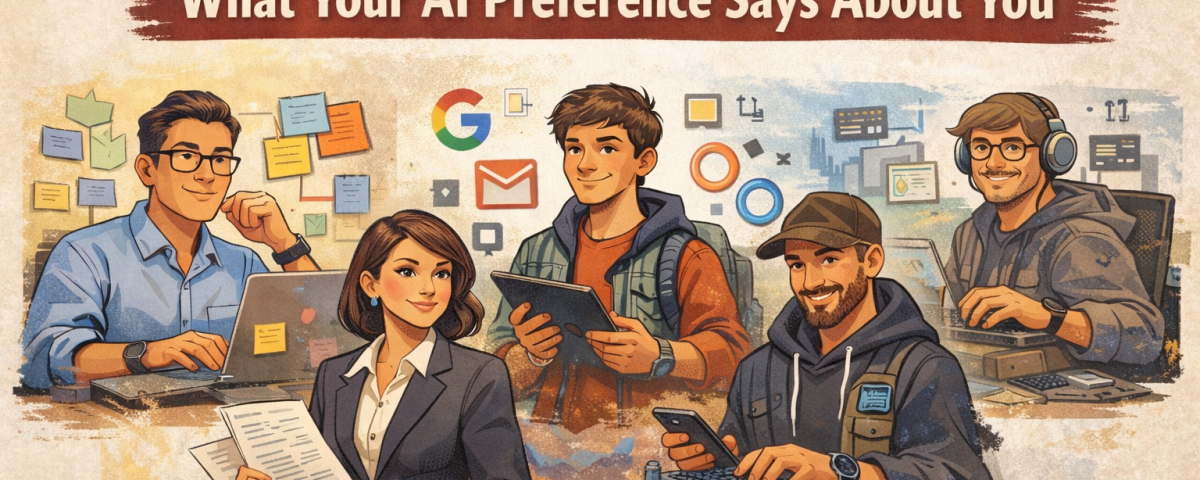
What Your AI Tool Preference Says About You
By Daclaud Lee
Everyone has a favorite AI tool, but the one you use most often says a lot about how you think and work. Some people treat AI like a research assistant, others use it as a creative engine, and some see it as a productivity machine. Here’s a breakdown of the most popular AI tools and the personality archetypes that tend to gravitate toward each one.
The AI User Archetypes
Not all AI users approach these tools the same way. Some treat AI like a productivity engine, others use it as a research assistant, and some see it as a creative partner for building entire worlds. The AI platform you gravitate toward usually reflects how your brain works, how you solve problems, and what you’re trying to accomplish with the technology.
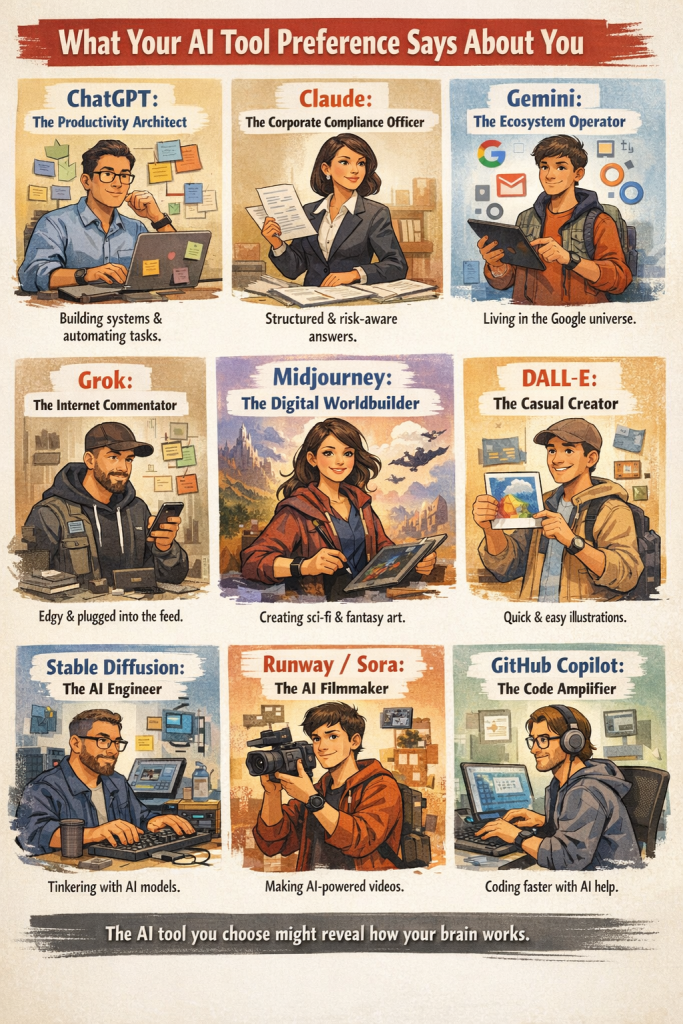
ChatGPT (OpenAI)
Archetype: The Productivity Architect
This is the person who treats AI like a Swiss Army knife. If something can be organized, automated, rewritten, brainstormed, or optimized, they’re already feeding it into ChatGPT. Their brain basically runs on systems, prompts, and templates at this point.
Strength: Extremely versatile.
Weakness: Might start outsourcing too much thinking.
DALL E
Archetype: The Casual Creator
DALL E users usually just want something quick. They describe an idea and expect an image without learning a complicated prompt language. It’s perfect for quick concepts, blog graphics, and random visual experiments.
Strength: Easy and fast.
Weakness: Less control over the final result.
Gemini (Google)
Archetype: The Ecosystem Operator
Gemini users are already living inside the Google universe. Gmail, Docs, Sheets, Chrome, Search, Drive. Adding Gemini just feels like another extension of the tools they already use every day. They’re not chasing the flashiest AI features. They just want something that works inside the system they already depend on.
Strength: Seamless integration.
Weakness: Not always the most imaginative AI.
Grok (xAI)
Archetype: The Internet Commentator / Edgelord
Grok users usually live deep inside online discourse. They like an AI that feels current, sarcastic, and aware of what’s happening on the internet right now. Instead of a polished corporate assistant, they want something that feels like it’s scrolling the same timeline they are.
Strength: Real time awareness and cultural context.
Weakness: Sometimes feels a little too online.
GitHub Copilot / Cursor
Archetype: The Code Amplifier
Developers using these tools treat AI like a coding assistant that handles the repetitive stuff. Instead of writing every line from scratch, they let the AI fill in boilerplate while they focus on the bigger system design. It doesn’t replace programmers, it just speeds them up.
Strength: Speed and efficiency.
Weakness: Easy to forget syntax if you rely on it too much.
Claude (Anthropic)
Archetype: The Corporate Compliance Officer
Claude users tend to be the cautious ones in the room. They want structured answers, careful wording, and responses that won’t accidentally get anyone sued or canceled. If ChatGPT feels like a brainstorming partner, Claude feels like the AI you bring into a legal meeting.
Strength: Clear logic and structured explanations.
Weakness: Sometimes reads like HR approved every sentence.
Perplexity
Archetype: The Research Analyst
Perplexity users treat AI like a research assistant, not a conversation partner. They don’t want storytelling or philosophical rambling. They want sources, citations, and the ability to prove someone wrong in under thirty seconds.
Strength: Fast fact checking and citations.
Weakness: Not built for creative brainstorming.
Midjourney
Archetype: The Digital Worldbuilder
Midjourney users are the artists and world builders. They can spend hours tweaking prompts for lighting, composition, mood, and atmosphere just to get the exact image they imagined. To them, AI isn’t just an image generator. It’s a visual storytelling engine.
Strength: Incredible artistic output.
Weakness: Prompt tweaking becomes its own hobby.
Stable Diffusion
Archetype: The AI Engineer
Stable Diffusion users tend to be the technical crowd. These are the people running models locally, downloading checkpoints, tweaking settings, and building custom workflows. They don’t want a simple AI tool. They want full control over the engine.
Strength: Maximum customization.
Weakness: Setup can feel like assembling a spaceship.
Runway / Sora / Kling
Archetype: The AI Filmmaker
These users see AI as the future of filmmaking. Instead of just images, they’re experimenting with generated video, cinematic shots, and AI produced scenes. In their mind, this technology is basically a new type of movie studio.
Strength: Massive creative potential.
Weakness: The technology is still evolving.
The Real Takeaway From AI Tool Archetypes
At the end of the day, the tool you choose says more about how you think than which AI is “better.” Some people want speed and productivity, others want research and verification, and some are simply here to create things that never existed before. None of these approaches are wrong because AI is just a tool that adapts to the way you work. The real advantage comes from understanding how to use these tools effectively rather than arguing about which one wins.

How to Use Google Search Console For Technical SEO
Google Search Console gives you a direct look at how Google discovers, crawls, indexes, and understands your website. By using real data from Google rather than relying on guesswork, you can identify indexing problems, crawl issues, Core Web Vitals concerns, and other technical problems that may be limiting your visibility in search results. In this guide, we’ll show you how we use Google Search Console for technical SEO to find problems, verify fixes, and help keep websites healthy and accessible to search engines.
What is Position 0?
Ranking on the first page of Google is no longer the only goal. Many searches are answered before users even click a website, thanks to Position 0, also known as a Featured Snippet. Earning this coveted placement can dramatically increase your visibility, establish your business as an authority, and drive more qualified traffic, even above the #1 organic search result.

How to Track SERP Position
Tracking your SERP (Search Engine Results Page) positions is one of the most important parts of any SEO strategy. By monitoring keyword rankings, businesses can measure the effectiveness of their SEO efforts, identify new opportunities, and spot ranking declines before they impact traffic and leads. Whether you’re managing a local business website or a national SEO campaign, knowing where your pages rank can help you make smarter marketing decisions.

EEAT SEO Explained: Experience, Expertise, Authority & Trust
Google has become increasingly focused on content quality, credibility, and trust. That’s where E-E-A-T comes in, a framework Google uses to evaluate the Experience, Expertise, Authoritativeness, and Trustworthiness of content and the people behind it.

Free Veteran Owned Logo
Free Veteran Owned Logo Show your service with pride and let customers know who they’re supporting. This free Veteran Owned logo is perfect for your website, social media, vehicles, and printed marketing materials. Just right click on the image and “Save As”. This is royalty free, so you can use it anywhere, and make your business stand out with a badge that builds trust instantly. Use This Logo to Represent Your Service and Your Business This free Veteran Owned logo can be used across any type of business to proudly showcase that you served your country. Whether you’re running a local service company, an online store, or a professional practice, adding this badge to your website, social media, vehicles, and
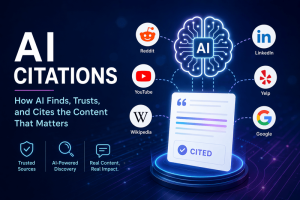
How to Get Your Business Cited by AI Using High-Authority Platforms
If you’re trying to rank in AI search results, your website alone isn’t enough anymore. The platforms AI trusts most are places like Reddit, YouTube, LinkedIn, and Yelp, where real content and engagement happen daily. If your business isn’t showing up on these sites, you’re missing a major piece of the visibility game.
