

SEO for divorce attorneys

SEO for Divorce Attorneys

By Daclaud Lee – SEO / AEO / AIO Consultant

When someone needs a divorce attorney, one of the first places they often turn is Google. A strong SEO strategy can help your law firm appear when potential clients are actively searching for divorce and family law services in your area. In this guide, we’ll cover practical SEO tips for divorce attorneys and explain how professional SEO can help your firm generate more qualified leads.

How to Get Your Law Firm Found Online

When someone searches for a divorce attorney, you want your law firm to appear before your competitors. SEO for divorce attorneys helps improve your visibility in Google Search, Google Maps, and local search results so potential clients can find your firm when they need legal help.

At Archmore Business Web, we help law firms build stronger search visibility through local SEO, website optimization, content development, keyword targeting, and technical SEO. The goal isn’t simply to generate more website traffic. It’s to help your firm get discovered by people who are actively searching for the divorce and family law services you provide.

Throughout this guide, we’ll show you some of the same strategies we use to help businesses improve their search presence, so you can start applying them to your own law firm’s website.

The Basics of SEO for Divorce Attorneys

SEO for divorce attorneys does not need to start with complicated strategies. The foundation is making sure Google can clearly understand what legal services you provide, where you provide them, and why your law firm is a credible and trustworthy choice. Here are ten areas we recommend focusing on.

1. Define Your Service Areas

Start by identifying the cities, counties, and communities where you actually want to attract divorce and family law clients. Your geographic targeting will influence your website content, local keywords, Google Business Profile strategy, service area pages, and local citations.

Do not simply target every city within 100 miles. Focus on markets where you realistically practice and where attracting new clients makes business sense.

2. Set Up and Optimize Your Google Business Profile

Your Google Business Profile is one of the most important components of local SEO. Make sure your business name, address, phone number, website, hours, categories, services, photos, and other information are accurate and complete.

Your primary and secondary categories should also accurately reflect your practice. The goal is to give Google clear information about your law firm while giving prospective clients enough information to determine whether you can help them.

3. Create Rich Service Content That Demonstrates E-E-A-T

Do not settle for a single page that simply says you handle divorce cases. Build substantial content around the legal services you actually provide, such as divorce, dissolution, child custody, child support, spousal support, property division, and other applicable areas of family law.

Your content should demonstrate Experience, Expertise, Authoritativeness, and Trustworthiness (E-E-A-T). Discuss the questions clients commonly ask, explain relevant legal concepts, introduce your attorneys and their experience, and provide genuinely useful information instead of simply repeating keywords.

4. Connect Your Social Media and Post Regularly

Maintain active, consistent social profiles and connect them to your overall online presence. You can share articles, legal updates, answers to common questions, firm news, videos, and other useful information.

Social activity is not a substitute for traditional SEO, but it can strengthen your broader digital footprint and create additional content and entity signals that may be surfaced or referenced across traditional search, AI Overviews, and other AI-driven discovery experiences.

5. Build Backlinks and Local Citations

A backlink is a link from another website to yours. A local citation is an online reference to your law firm, typically including information such as its name, address, and phone number.

Look for legitimate opportunities through local organizations, professional associations, chambers of commerce, community involvement, legal directories, sponsorships, media coverage, and useful content that other websites may naturally reference. Quality and relevance matter much more than simply accumulating hundreds of links.

6. Create Profiles on Major Attorney Directories

Attorney directories can provide additional places for prospective clients and search engines to find information about your practice. Depending on your jurisdiction and eligibility, directories and professional profiles worth evaluating include Avvo, FindLaw, Justia, Lawyers.com, Martindale-Hubbell, Super Lawyers, Nolo, and HG.org, along with relevant state and local bar association directories.

These profiles can provide citations, referral traffic, reputation signals, and, in some cases, backlinks and reviews. Keep your law firm’s information consistent across these platforms. You do not necessarily need to pay for every premium directory package simply because one is offered.

7. Build Service Area Pages

If you serve multiple communities, create useful service area pages for your most important markets. For example, instead of relying exclusively on one general divorce attorney page, you might have pages targeting specific cities where you genuinely provide services.

Do not simply duplicate the same page and swap the city name. Add information relevant to that location and the clients you serve there. Strong service area pages should be useful enough to stand on their own.

8. Consistently Ask Clients for Reviews

Reviews are particularly important for a business where trust plays such a significant role in the hiring decision. Encourage satisfied clients to leave honest reviews on appropriate platforms, especially Google.

Reviews can strengthen your reputation and local presence while providing prospective clients with independent evidence of other people’s experiences with your firm. They can also contribute to the broader trust and reputation signals surrounding your business online.

9. Post to Your Google Business Profile

You do not need to publish something every day. Instead, periodically use your Google Business Profile to share genuinely useful information.

You could discuss changes to divorce or family law, answer common questions, share new articles from your website, or highlight relevant firm news. The objective is not to post for the sake of posting. Use the profile as another place to demonstrate that your firm is active and knowledgeable about its practice areas.

10. Blog About the Questions Your Clients Are Actually Asking

A good legal blog should answer the questions prospective clients are typing into Google. Topics might include how property is divided during a divorce, how child custody works, what happens to a house during divorce, how long a divorce takes, or what someone should bring to their first consultation.

Provide genuinely helpful information rather than writing articles solely to target keywords. These articles can strengthen your website’s topical depth, demonstrate your attorneys’ expertise, create internal-linking opportunities, and give you useful content to share through your Google Business Profile and social channels.

Keyword Research for Divorce Attorneys

Effective SEO for divorce attorneys begins with identifying the keywords potential clients use when searching for legal representation. Unlike general website traffic, the goal of divorce attorney SEO is to attract individuals who need legal assistance with divorce, child custody, property division, spousal support, and other family law matters. Targeting the right keywords helps your law firm reach prospective clients at different stages of their decision-making process, from researching divorce procedures to scheduling an initial consultation.

At Archmore Business Web, we approach keyword research by evaluating four important factors: legal services, geographic relevance, keyword competition, and search intent. We use SEO tools such as Semrush, Google Search Console, and BrightLocal to identify relevant search opportunities, examine competing law firms, and track keyword performance. Rather than selecting keywords based solely on estimated search volume, we prioritize terms that align with the attorney’s practice areas, service locations, and potential to generate qualified inquiries.

For example, a divorce attorney practicing in Columbus, Ohio, might benefit from targeting “divorce attorney Columbus Ohio” on a primary service page while creating additional pages for contested divorce, uncontested divorce, child custody, and other services the firm actually provides. More specialized searches, such as “international divorce lawyer,” may have narrower audiences but attract individuals seeking specific legal expertise. Informational searches can also provide opportunities to educate potential clients and establish the firm’s authority.

Examples of SEO Keywords for Divorce Attorneys

The following examples illustrate how different keywords can serve different purposes within a divorce law firm’s SEO strategy.

Keyword ExampleSearch Intent
Divorce attorney Columbus OhioLocal, hiring an attorney
Contested divorce lawyerService-specific, commercial
Uncontested divorce attorneyService-specific, commercial
International divorce lawyerSpecialized legal services
How much does divorce cost in Ohio?Informational, legal research
Child custody attorney near meLocal, hiring an attorney


These keywords are illustrative examples, not verified search-volume or keyword-difficulty recommendations.

Understanding search intent is particularly important because not every visitor is ready to hire an attorney. Someone searching “how much does divorce cost in Ohio?” may be researching their options, while someone searching “divorce attorney near me” is more likely to be evaluating legal representation. A successful SEO strategy accounts for both audiences by combining informative legal resources with optimized service pages designed to encourage consultation requests.

Geographic targeting also plays an important role. Divorce attorneys typically serve clients within particular jurisdictions, and their SEO strategies should reflect where they are licensed, where they practice, and which courts or communities they serve. Creating relevant content for actual service areas can help firms compete for local searches, but publishing nearly identical pages for dozens of cities without meaningful differences can create low-value content.

The objective of keyword research isn’t simply to rank for the most popular divorce-related searches. It’s to identify the searches most likely to connect your law firm with people who need the legal services you provide.

How We Build an SEO Strategy for Divorce Law Firms

At Archmore Business Web, we understand that divorce attorneys operate in a highly competitive market where visibility, credibility, and reputation matter. A law firm’s website must do more than attract visitors. It needs to demonstrate relevant legal experience, explain available services, and make it easy for prospective clients to take the next step. That’s why our approach to SEO for divorce attorneys combines technical optimization, competitive research, content development, and ongoing performance measurement.

We don’t believe in treating every law firm exactly the same. An attorney concentrating on uncontested divorce in a single metropolitan area has different SEO requirements from a family law practice handling high-asset divorce, interstate custody disputes, and international family law matters. Our strategy begins by understanding the firm’s practice areas, target markets, existing website performance, and business objectives.

SEO Audits and Website Analysis

We begin by examining the law firm’s existing website to identify opportunities and technical problems that may be limiting organic search visibility. This includes reviewing page titles, headings, content quality, internal links, indexing status, canonical tags, mobile usability, and website performance. We also examine the site’s architecture to determine whether important practice areas have dedicated pages and whether visitors can easily navigate between related services.

Using Google Search Console and other SEO tools, we can investigate which pages already receive search impressions, which queries generate traffic, and where additional optimization may be beneficial. This gives us a starting point for prioritizing improvements instead of making changes without understanding the website’s existing performance.

Keyword Research and Competitor Analysis

Once we understand the website’s condition, we research the keywords potential clients use to find divorce and family law attorneys. We evaluate practice-area keywords, location-specific searches, and informational queries that may lead prospective clients to the firm. We also examine competing law firm websites to understand which topics they cover, how their service pages are organized, and which search terms may be contributing to their visibility.

Tools such as Semrush help us investigate competitor keyword opportunities and identify potential content gaps. BrightLocal can be used to monitor selected local keyword rankings, while Google Search Console provides actual search performance data for the firm’s website. By combining these resources, we develop a keyword strategy based on relevance and measurable opportunities rather than assumptions.

Practice-Area Pages and Content Development

Divorce attorneys frequently provide multiple services that deserve individual attention. Instead of attempting to rank one general family law page for every possible search, we evaluate whether dedicated pages would better explain the firm’s actual services. These may include contested divorce, uncontested divorce, child custody, spousal support, property division, high-asset divorce, and international divorce.

Each page should explain the relevant legal service, address common client concerns, and provide useful information about the firm’s approach. We also consider opportunities for educational articles that answer frequently searched questions. Because legal information can influence significant personal and financial decisions, substantive legal content should be reviewed by a qualified attorney for accuracy, jurisdictional relevance, and compliance before publication.

Geographic Targeting and Local SEO

For divorce attorneys serving specific cities or counties, local SEO is a major component of the strategy. We evaluate the firm’s Google Business Profile, business information consistency, relevant local listings, and geographic keyword opportunities. We also consider whether the website adequately communicates the communities and jurisdictions the attorney serves.

For example, a Columbus-based divorce attorney may serve clients throughout Franklin County and surrounding areas. Relevant service-area content can help explain that geographic reach, provided the information is accurate and useful. We avoid creating misleading office locations or suggesting that an attorney maintains a physical presence in communities where no legitimate office exists.

Internal Linking and Website Architecture

Internal linking helps connect the firm’s practice-area pages, educational resources, attorney biographies, and contact information. A page explaining Ohio divorce procedures might link to relevant pages about contested divorce, property division, or child custody. These connections help prospective clients explore related legal issues while allowing search engines to better understand the relationship between the website’s content.

We also examine navigation menus, service categories, and calls to action to ensure important pages are easy to find. An organized website can improve the user experience while supporting search engine crawling and content discovery.

Ongoing SEO Reporting and Optimization

SEO requires ongoing evaluation because search results, competitors, and client search behavior change over time. At Archmore Business Web, we use keyword tracking and performance reports to evaluate search visibility and identify opportunities for improvement. We typically review targeted keyword rankings through BrightLocal, examine Google Search Console data, and use competitive research tools when additional analysis is needed.

Our reporting focuses on meaningful trends rather than reacting to every daily ranking fluctuation. We examine which pages are gaining visibility, which keywords require additional work, and where content or technical improvements may support better performance. When conversion tracking is available, we can also evaluate whether organic search traffic is contributing to consultation inquiries and other important business goals.

Our goal is to develop an SEO strategy that helps divorce attorneys reach relevant prospective clients, strengthen their online presence, and build sustainable organic search visibility.

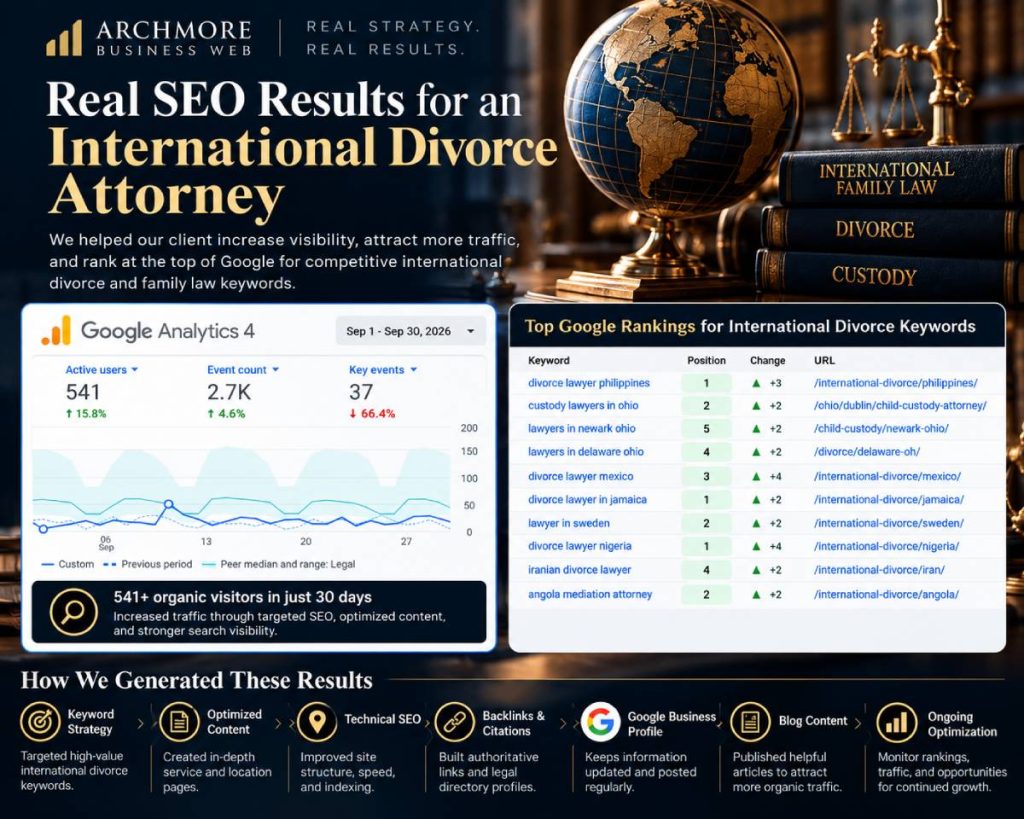
Case Study: Divorce and International Divorce Attorney

Getting these results did not come from optimizing a handful of keywords. We built out the website around the attorney’s actual practice areas, geographic reach, and international divorce services. This gave search engines a much clearer understanding of what he does, where he practices, and the specific types of clients he can help.

International divorce attorney SEO

1. We Built Pages for Each of His Legal Services

Instead of trying to make one general page rank for everything, we created and optimized dedicated pages around his individual practice areas. This allowed us to target more specific searches while providing potential clients with detailed information about the services they were looking for.

  • Family Law
  • Divorce Law
  • International Divorce Law
  •  Child Custody
  • Dissolution
  • Child Custody Across Multiple States
  • Hague Convention
  • Spousal Support
  • International Child Abduction
  • Domestic Appeals
  • Family Mediation and Arbitration
  • International Family Law

2. We Optimized for the Countries Where He Handles International Divorce

International divorce is one of his specialties, so we expanded the website around the individual countries relevant to his practice. Instead of relying solely on a general International Divorce page, we created country-specific content designed to answer more targeted searches.

This is how the website began ranking for searches such as Divorce Lawyer Philippines, Divorce Lawyer Mexico, Divorce Lawyer Jamaica, Divorce Lawyer Nigeria, Iranian Divorce Lawyer, and other international divorce terms.

3. We Targeted the States Where He Handles Child Custody Matters

We applied a similar strategy to multi-state child custody. We created and optimized content around the states where he is able to handle these matters, giving Google more specific pages to match with people searching for child custody attorneys and information involving those states.

4. We Optimized for Cities and Towns Throughout Franklin County

We also built out the firm’s local SEO presence. This included optimizing the website for the individual cities and communities throughout Franklin County where potential clients may be searching for divorce and family law attorneys.

Rather than simply targeting broad terms like Divorce Attorney Columbus Ohio, this strategy allows the firm to compete for more specific local searches throughout its actual service area.

5. We Expanded the Strategy to Relevant Counties

Our geographic strategy did not stop with individual cities. We also optimized the website around the counties where the attorney is able to practice and wants to attract clients.
This creates multiple layers of geographic relevance, allowing the website to target city, county, state, national, and international searches depending on the particular legal service.

6. We Continue to Strengthen the Website Using E-E-A-T

SEO is not finished once a page starts ranking. We continue reviewing and improving the website based on E-E-A-T: Experience, Expertise, Authoritativeness, and Trustworthiness.

That means strengthening existing content, demonstrating real legal knowledge and experience, improving trust signals, keeping information useful and current, and continuing to build the firm’s authority around the areas of law it actually practices.

The result is a website built around the attorney’s real expertise rather than a collection of generic SEO pages.

Frequently Asked Questions About SEO for Divorce Attorneys

What Is SEO for Divorce Attorneys?

SEO for divorce attorneys is the process of improving a law firm’s visibility in search engines for searches related to divorce, family law, child custody, and other relevant legal services. The goal is to help potential clients find your firm when they are actively searching for the services you provide.

Many potential clients begin their search for an attorney online. Strong SEO can help your firm appear for relevant searches at the moment someone is looking for legal assistance, increasing your visibility and opportunities to generate qualified leads.

SEO is a long-term strategy, and there is no guaranteed timeline. Competition, your existing website authority, location, content, backlinks, and the keywords you are targeting can all affect how quickly rankings improve.

Divorce attorneys should generally target keywords related to their actual services and geographic markets. Examples include Divorce Attorney, Family Law Attorney, Child Custody Lawyer, International Divorce Attorney, and combinations such as Divorce Attorney + City or Divorce Attorney + County.

For firms seeking local clients, a well-optimized Google Business Profile can be an important part of local SEO. Keep your business information accurate, select appropriate categories, add relevant information and photos, and consistently work on earning legitimate client reviews.

Reviews can support local visibility and provide important trust signals for prospective clients. Encourage satisfied clients to leave honest reviews, but never buy reviews or attempt to manipulate ratings.

Yes, when there is enough useful information to justify them. Divorce, child custody, dissolution, spousal support, mediation, international divorce, and other distinct practice areas can benefit from dedicated pages rather than forcing every service onto one general family law page.

City and service area pages can help a firm target relevant geographic searches, but each page should provide genuine value. Avoid creating dozens of nearly identical pages where the only difference is the city name.

Blogging can help attorneys answer questions potential clients are already searching for while demonstrating knowledge and building topical depth around their practice areas. Focus on useful legal information and questions relevant to the firm’s actual clients rather than publishing articles simply to add keywords.

SEO can increase a firm’s visibility among people searching for divorce and family law services, which can create more opportunities for inquiries and consultations. However, rankings and leads are never guaranteed, and results depend on factors such as competition, market demand, website quality, reputation, and the strength of the overall SEO strategy.

Yes. Archmore Business Web can evaluate your current search presence, identify opportunities, and develop an SEO strategy around your practice areas and geographic markets. Start with an SEO Report Card to see what’s working, what needs improvement, and where your law firm has opportunities to grow.

About the Author

Daclaud Lee is a digital marketing professional, author, and business consultant who has worked in SEO since 2010. A graduate of Franklin University’s Digital Marketing program, he has spent more than 15 years helping businesses improve their online visibility through search engine optimization, website development, content strategy, and digital marketing.

Through his work as a SEO consultant, Daclaud combines hands-on SEO experience with a practical understanding of how businesses use their websites to attract customers and generate leads. He also writes on topics related to SEO, digital marketing, business, and technology.

More From the Blog

Want to learn more about SEO, website optimization, and digital marketing? Explore more articles from the Archmore Business Web Blog for practical tips, strategies, and insights you can use to improve your website and online visibility.

Continue exploring the Digital Marketing Journal and discover more ways to grow your online presence with Archmore Business Web.

SEO for beginners

The Beginner’s Guide to SEO (Search Engine Optimization)

Are you new to SEO? Do you want to know more about what a SEO professional does? The Archmore Guide to SEO provides the basics of Search Engine Optimization so you understand exactly what SEO is and how it can help with your website and keyword rankings. It also gives you a better idea of what we do on a daily basis as SEO consultants and as a Digital Marketing company. What is SEO? SEO in a nutshell is the process of getting your website or web page indexed in a search engine. Black Hat SEO and White Hat SEO There are many types of SEO practices, the two types are Black Hat SEO and White Hat SEO. Obviously Black Hat SEO

Read More »
Pringles Once Your Drop featured image Dan the Funeral Man

Pringles Once You Drop Marketing Campaign

What if your favorite snack company offered to bury you in its packaging when you die? That’s essentially the premise behind the Pringles Once You Drop Halloween contest, a bizarre new marketing campaign offering one lucky fan a custom Pringles-can urn and an “afterlifetime” supply of potato crisps. It’s a promotion that combines funeral humor, influencer marketing, and a genuinely strange piece of company history.

Read More »
SEO Report Card

SEO Report Card

How well is your website actually performing in Google Search? An SEO Report Card gives you a straightforward look at your website’s search visibility, keyword rankings, content, technical SEO, and other important performance factors. We can generate an SEO Report Card to identify what your website is doing well, where problems may exist, and where there are opportunities to improve your rankings.
Read More »
Google Search Console in action

How to Use Google Search Console For Technical SEO

Google Search Console gives you a direct look at how Google discovers, crawls, indexes, and understands your website. By using real data from Google rather than relying on guesswork, you can identify indexing problems, crawl issues, Core Web Vitals concerns, and other technical problems that may be limiting your visibility in search results. In this guide, we’ll show you how we use Google Search Console for technical SEO to find problems, verify fixes, and help keep websites healthy and accessible to search engines.
Read More »
What is Position 0 cover showing an example

What is Position 0?

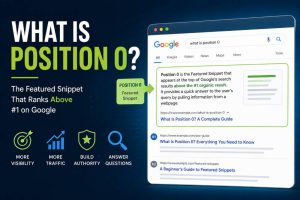
Ranking on the first page of Google is no longer the only goal. Many searches are answered before users even click a website, thanks to Position 0, also known as a Featured Snippet. Earning this coveted placement can dramatically increase your visibility, establish your business as an authority, and drive more qualified traffic, even above the #1 organic search result.

Read More »

How to Track SERP Position

Tracking your SERP (Search Engine Results Page) positions is one of the most important parts of any SEO strategy. By monitoring keyword rankings, businesses can measure the effectiveness of their SEO efforts, identify new opportunities, and spot ranking declines before they impact traffic and leads. Whether you’re managing a local business website or a national SEO campaign, knowing where your pages rank can help you make smarter marketing decisions.

Read More »