


How to Get .edu Links: The Truth and the Lies

By Daclaud Lee

We far are into the 2020’s decade, and I can’t believe There are still grifters out there claiming to be an SEO “expert”, that loves to claim that .edu backlinks are a shortcut to higher rankings. Decades ago, especially in the early 2000s, the industry inflated .edu links into a mythical ranking weapon that supposedly guaranteed page one results. The reality is far less dramatic, and far more important to understand if you care about sustainable, long-term authority instead of hype driven tactics.

If you are searching for how to get .edu links, you need clarity before you waste money on mass packages and empty promises.

The .edu Link Grift: How Hype Became a Product

Before we talk about the lies, we need to address the business model behind them.

The .edu backlink obsession became profitable because it is easy to package and sell. Agencies discovered that business owners associate “.edu” with authority, so they began offering bulk link packages that sound exclusive and powerful. Instead of earning real editorial placements, many sellers rely on automated submissions, abandoned student pages, low quality resource listings, or loosely moderated university subdomains.

It looks impressive in a report. It feels technical. It sounds elite.

But in reality, it is often a volume based grift built on misunderstanding how search engines evaluate authority.

The Lie: Thousands of .edu Links Will Skyrocket Your Rankings

If someone claims they can sell you hundreds or thousands of .edu backlinks, stop immediately. Universities do not hand out bulk editorial links to random businesses. When you see volume promises, you are usually looking at profile page spam, low quality resource pages, hacked placements, or automated submissions that carry little to no ranking value.

Search engines do not reward domain extensions. They reward relevance, authority, and editorial trust.

The Lie: All .edu Links Carry Massive Authority

Not all .edu pages are powerful. A forgotten student club subdomain with zero traffic and 200 outbound links is not a golden ticket. Authority is determined at the page level, not by the domain extension alone.

A relevant backlink from a respected local publication can outperform a weak, irrelevant .edu placement every time.

a shady salesman trying to sell you .edu backlinks with fake degrees in floating above him.

The Truth About How to Properly Get .edu Backlinks

If you are serious about learning how to get .edu links (the truth and the lies), understand this first: real .edu backlinks are difficult because they require legitimacy.

They do not come from hijacking abandoned student accounts.
They do not come from posting on forgotten university forums.
They do not come from mass emailing financial aid departments with fake “scholarship” pages created purely for link bait.

Those tactics are either temporary, low value, or outright manipulative. At best, they get ignored. At worst, they get removed or flagged.

Proper .edu backlinks require institutional alignment. Universities are structured organizations. Departments, faculty, procurement offices, and communications teams control what gets published. If you want a real link, you must have a real reason to be listed.

That means: You are contributing to a program legitimately.

  • You are collaborating academically or professionally
  • You are sponsoring something meaningful
  • You are recognized as a legitimate partner
  • There is no automation shortcut for credibility.

The Truth: Real .edu Links Are Earned, Not Manufactured

If you want to know how to get .edu links (the truth and the lies), here is the honest answer: you earn them through legitimate relationships.

That can include:

  • Sponsoring university programs
  • Offering internships
  • Partnering on research
  • Guest lecturing
  • Providing scholarships with genuine institutional recognition
  • Being listed as an approved vendor

These links happen because you are providing real value, not because you purchased a package.

The Truth: Relevance Beats Extension

A university link only matters if it makes contextual sense. If you run a local service business, a link from a relevant department, business program, or community resource page may help. A random biology department resource page in another state will not.

Search engines measure topical alignment, not vanity metrics.

The Rise and Fall of the .edu Backlink Myth

There was a time when .edu backlinks were treated like a cheat code. If you landed one, you felt like you unlocked something elite. But the story of .edu links is not about magic domains, it is about how the SEO industry misunderstood correlation and turned it into a product.

Let’s walk through how this narrative evolved.

Early 2000s: When Authority Actually Meant Something

Back in the early PageRank era, university domains were powerful. They were old, heavily linked to, academically referenced, and rarely spammed. If you earned a legitimate link from a university site, you were benefiting from a genuinely strong domain with real trust behind it.

It was not the extension that mattered. It was the authority profile of the site.

But most people did not analyze it that deeply. They just saw rankings move and drew a simple conclusion: “.edu links are powerful.”

Mid 2000s: The Industry Simplifies the Story

Instead of explaining page level authority, link equity, and domain trust, the SEO world condensed the lesson into something easier to sell.

“.edu equals rankings.”

That is when the mythology began. Once business owners heard that universities carried authority, demand exploded. And where there is demand in SEO, there is always someone ready to manufacture supply.

2010 to 2014: The Exploitation Phase

This is when the scholarship strategy took off. Agencies created generic scholarship pages, blasted emails to financial aid departments, and secured placements on low quality resource pages.

At scale, it worked for a while. Google’s spam detection was less sophisticated, and sheer domain strength masked low quality placements.

Then the quality of those pages declined. University sites became cluttered with outbound SEO links. What started as editorial recognition became transactional placement.

And Google adapted.

Post Penguin Era: Reality Sets In

When Google rolled out Penguin and tightened link evaluation, things shifted fast.

Suddenly:

  • Link patterns mattered
  • Relevance mattered
  • Anchor text manipulation mattered
  • Spam signals were detected

Irrelevant .edu links stopped moving the needle. Manipulative placements got ignored or devalued.

The extension alone was no longer enough.

Today: Context Over Extension

Now Google evaluates links based on:

  • Page level authority
  • Contextual alignment
  • Editorial integrity
  • Traffic signals
  • Topical relevance

A strong, relevant local news backlink can outperform a weak .edu page every time.

The myth survives because it sounds prestigious. Universities feel authoritative, so the assumption carries psychological weight. But algorithms do not rank based on prestige branding. They rank based on trust, relevance, and authority flow.

The truth fits the narrative of this article: .edu links were never magic. They were strong when they were legitimate, rare, and contextually earned. Once they became a commodity, their edge disappeared.

The Real Lesson About .edu Links and What To Do Next

The takeaway is simple: chasing domain extensions is not a strategy. Authority is earned through relevance, trust, and real relationships, not through manufactured shortcuts. If you care about long term rankings, focus on building assets that compound instead of tactics that fade.

If this breakdown on how to get .edu links (the truth and the lies) gave you clarity, there is more where that came from. Explore our other SEO articles to understand what actually drives rankings in today’s algorithm — from local authority building to AI optimization and modern search strategy.

Read through our blog roll and build your SEO foundation the right way.

SEO for beginners

The Beginner’s Guide to SEO (Search Engine Optimization)

Are you new to SEO? Do you want to know more about what a SEO professional does? The Archmore Guide to SEO provides the basics of Search Engine Optimization so you understand exactly what SEO is and how it can help with your website and keyword rankings. It also gives you a better idea of what we do on a daily basis as SEO consultants and as a Digital Marketing company. What is SEO? SEO in a nutshell is the process of getting your website or web page indexed in a search engine. Black Hat SEO and White Hat SEO There are many types of SEO practices, the two types are Black Hat SEO and White Hat SEO. Obviously Black Hat SEO

Read More »
Pringles Once Your Drop featured image Dan the Funeral Man

Pringles Once You Drop Marketing Campaign

What if your favorite snack company offered to bury you in its packaging when you die? That’s essentially the premise behind the Pringles Once You Drop Halloween contest, a bizarre new marketing campaign offering one lucky fan a custom Pringles-can urn and an “afterlifetime” supply of potato crisps. It’s a promotion that combines funeral humor, influencer marketing, and a genuinely strange piece of company history.

Read More »
SEO for divorce attorneys

SEO for Divorce Attorneys

When someone needs a divorce attorney, one of the first places they often turn is Google. A strong SEO strategy can help your law firm appear when potential clients are actively searching for divorce and family law services in your area. In this guide, we’ll cover practical SEO tips for divorce attorneys and explain how professional SEO can help your firm generate more qualified leads.
Read More »
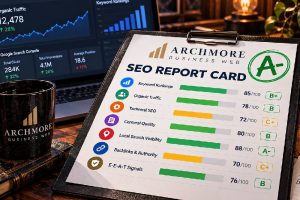
SEO Report Card

SEO Report Card

How well is your website actually performing in Google Search? An SEO Report Card gives you a straightforward look at your website’s search visibility, keyword rankings, content, technical SEO, and other important performance factors. We can generate an SEO Report Card to identify what your website is doing well, where problems may exist, and where there are opportunities to improve your rankings.
Read More »
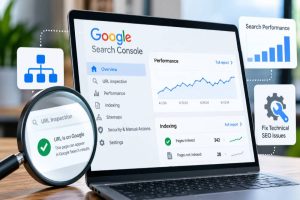
Google Search Console in action

How to Use Google Search Console For Technical SEO

Google Search Console gives you a direct look at how Google discovers, crawls, indexes, and understands your website. By using real data from Google rather than relying on guesswork, you can identify indexing problems, crawl issues, Core Web Vitals concerns, and other technical problems that may be limiting your visibility in search results. In this guide, we’ll show you how we use Google Search Console for technical SEO to find problems, verify fixes, and help keep websites healthy and accessible to search engines.
Read More »
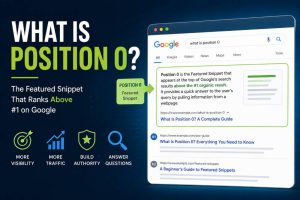
What is Position 0 cover showing an example

What is Position 0?

Ranking on the first page of Google is no longer the only goal. Many searches are answered before users even click a website, thanks to Position 0, also known as a Featured Snippet. Earning this coveted placement can dramatically increase your visibility, establish your business as an authority, and drive more qualified traffic, even above the #1 organic search result.

Read More »